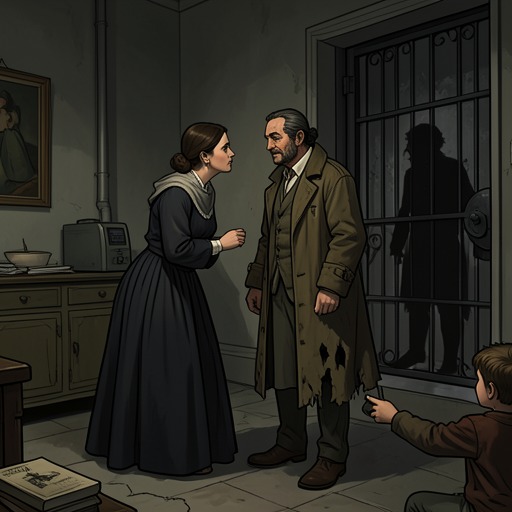
Guillaume de Roussillon
The DecameronGuillaume de Roussillon is a Provençal knight whose murder of his closest companion and calculated serving of the dead man’s heart to his own wife make friendship, jealousy, and revenge collapse into one domestic tragedy. His wife dies by her own hand after learning what she has eaten; Roussillon, dismayed by the result and afraid of the consequences, flees, while the two lovers are buried together in her family chapel.
Identity and Standing
In the account the king tells, Roussillon is one of two noble Provençal knights, each possessing castles and vassals. The other is Guillaume de Guardestaing. Their standing is marked not only by rank and property but by their public life as fellow warriors: they are renowned for prowess in arms, habitually travel together, and wear the same colors at tournaments, jousts, and other martial gatherings. Their castles lie roughly ten miles apart, close enough for companionship but distinct enough to sustain separate households.
Roussillon’s marriage forms the private setting for a friendship that has seemed exceptionally strong. He has a wife described as fair and lovable; the tale does not give her a personal name. For a time, the bond between the two knights appears more secure than the distance between their homes might suggest. That apparent solidarity makes Roussillon’s eventual invitation to Guardestaing all the more treacherous: he summons the friend who trusts him under the pretext of planning a journey to a tournament.
Friendship Turned to Vengeance
Guardestaing becomes passionately enamored of Roussillon’s wife despite the friendship and fellowship between the men. He pursues her by various means; she learns of his passion, welcomes it, and returns his love. They meet more than once. Their intimacy is not discreet enough to escape Roussillon’s notice, and his response is immediate and absolute: the great love he had borne Guardestaing turns into mortal hatred.
Roussillon conceals that hatred more successfully than the lovers have concealed their affair. When a tournament is announced in France, he informs Guardestaing and invites him to come so they can consider whether and how to attend. Guardestaing readily accepts, expecting to sup with his friend the next day. Roussillon treats that trust as an opportunity to arrange the killing. He arms himself, rides out with a servant, and waits in a wood about a mile from his castle, on the route Guardestaing must take.
Guardestaing arrives unarmed, followed by two servants who are also unarmed. Roussillon rushes from concealment with a lance, calls him a traitor, and strikes him in the breast before he can defend himself or even speak. The two servants flee toward their lord’s castle without stopping to learn who attacked him. Roussillon then dismounts, opens the dead man’s breast with a knife, and tears out his heart with his own hands. He wraps it in a lance pennon, gives it to one of his men to carry, forbids anyone to speak of the deed, and returns to his castle after nightfall.
The Heart at the Table
Roussillon’s wife has been waiting impatiently for Guardestaing, who was expected to supper that evening. When she asks why he has not arrived, her husband falsely says that Guardestaing sent word he cannot come until the following day. She is troubled, but does not yet know what has happened. Roussillon calls for the cook and orders him to prepare the heart as a rich, carefully seasoned dish, to be served in a silver porringer. He identifies it to the cook as a wild boar’s heart.
At table, Roussillon eats little, occupied by the deed he has committed. He has the dish set before his wife, pretends to be indisposed, and strongly recommends it. She tastes it, finds it good, and eats the whole serving. Only then does he disclose that it was Guardestaing’s heart, which he himself tore from the knight’s breast. The meal thus becomes the instrument of a second assault: Roussillon makes his wife consume the remains of the man she loved, then forces her to confront both the killing and his deliberate concealment of it.
Death, Flight, and Narrative Significance
The wife calls Roussillon disloyal and base. She argues that, if she gave her love to Guardestaing without being compelled, she—not the man she loved—should have borne the penalty. She refuses to let any further food follow what she describes as the heart of a noble and courteous knight. Rising from the table, she throws herself backward through a window high above the ground and is killed by the fall.
Roussillon is dismayed when he sees her die and feels that he has acted ill. Yet the account records no attempt to repair what he has done: afraid of the local people and the Count of Provence, he has his horses saddled and escapes. The next day, those close to Guardestaing and the dead woman take up both bodies in grief and lamentation. They place them in the same sepulchre, in the chapel of her own castle, and verses there record who lies within and the manner and cause of their deaths.
The king presents Roussillon’s story after another tale of unhappy love, promising the listeners a tragedy deserving of equal pity. Its central reversal is stark: the knight who once shared colors, arms, and fellowship with Guardestaing uses the trust created by that intimacy to kill him. His attempt to turn the lover’s heart into an instrument of punishment instead produces a joined burial for the lovers and Roussillon’s own flight. The shared tomb gives the tale its final counterimage to his betrayal: the two people he sought to separate in life are united in death, while he is left outside their grave and absent from the account’s ending.